
15th Oct 2026
John Jenkins Designs Preview: Third Carnatic War
During the Seven Years' War, the regiment ranked 69th and was under the command of, from December 1, 1745, Jean-François-Hubert Le Ver, Marquis de Caux and from 1759, Jules-Marc-Antoine de Morel, Marquis d'Aubigny.
An ordonnance, dated November 10, 1756, stipulated that the second battalion of the regiment would be sent to India and instructed to increase the effective strength of the regiment to 1,080 men (excluding officers)
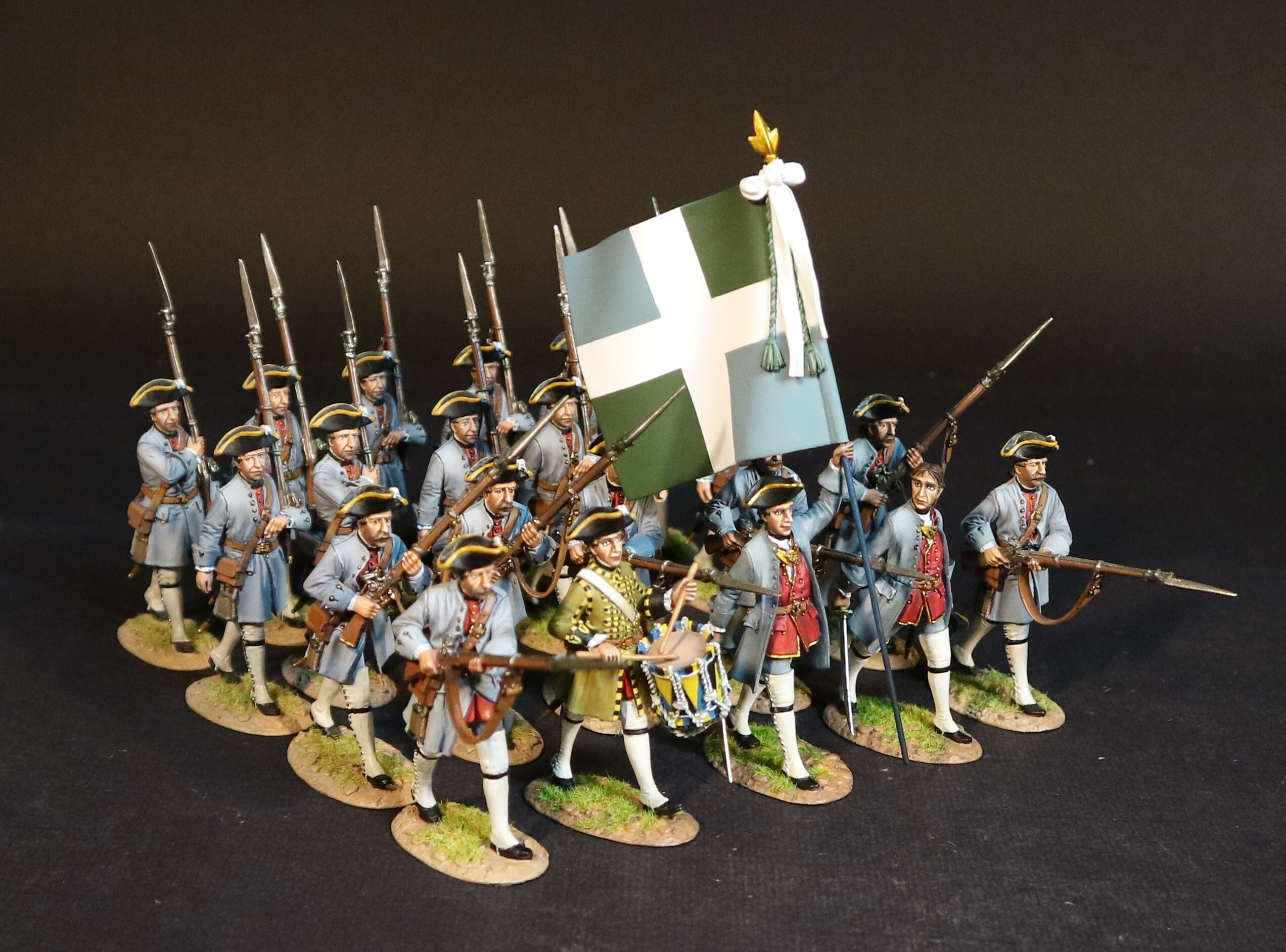
Furthermore, for service in India, the second battalion would be split into two distinct battalions (2nd and 3rd).
For the duration of the Seven Years' War, the 1st battalion remained in Europe.
On March 6, 1757, the 2nd and 3rd battalions of the regiment left Brest on board a squadron under the command of Admiral d'Aché to reinforce the French posts in India. The fleet pursued by British men-of-war loitered on the voyage to Île de France (present-day Mauritius). It then took three months on their passage to the Coast of Coromandel in India.
On April 25, 1758, d'Aché's squadron finally arrived before the British Fort St-David. The 2nd and 3rd battalions (a total of 983 men) then took part in the Operations on the coast of Coromandel.
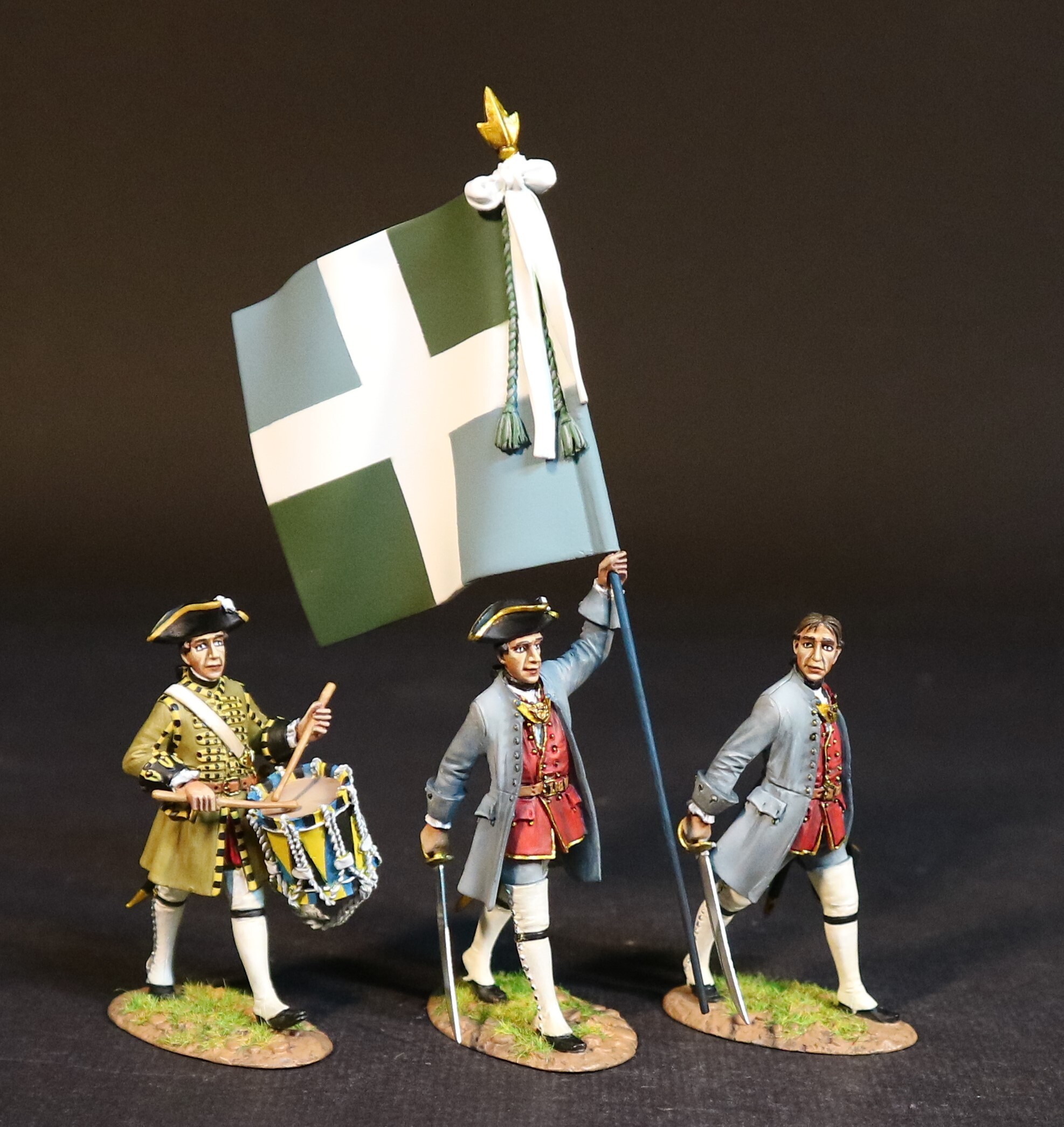
On April 30th, these battalions were part of M. de Soupire’s force who joined d’Estaing for the siege of Fort St. David until its capitulation on June 2nd.
The two battalions were at the Battle of Condore on December 9th.
In 1759, they took part in the unsuccessful siege of Madras
On January 22nd 1760, 400 men of the battalion took part in the Battle of Wandewash.
The initial disposition of the French army was formed in a single line with the Lally Infanterie on the left flank, the Bataillon de I’Inde in the centre and the Lorraine Infanterie on the right, formed in line of battle. Artillery was positioned between each battalion.
About 400 Indian infantry occupied an area to the rear, with 900 Cipayes on a ridge before the camp.
Both lines halted within 200 meters of each other and opened a heavy fire of musketry. The 84th Coote’s Foot had fired but 2 rounds, when Lally formed the Lorraine Infanterie on the French right into a column of 12 abreast and ordered it to charge with the bayonet.
The British met the column with line, and reserved their fire until the French were within 50 meters and then poured a volley which tore the front and flanks of the Lorraine Infanterie to tatters. The gallant Frenchmen, unchecked by their losses, pressed on the faster and in another minute the two regiments had closed and were fighting furiously hand to hand. The column broke by sheer weight through the small fragment of line opposed to it but the remainder of the 84th Coote’s foot closed instantly upon its flanks, and after a short struggle, the French already shaken by the volley, broke up in confusion and ran back to the camp, with the British in pursuit, carrying dismay into the ranks of the Cipayes.
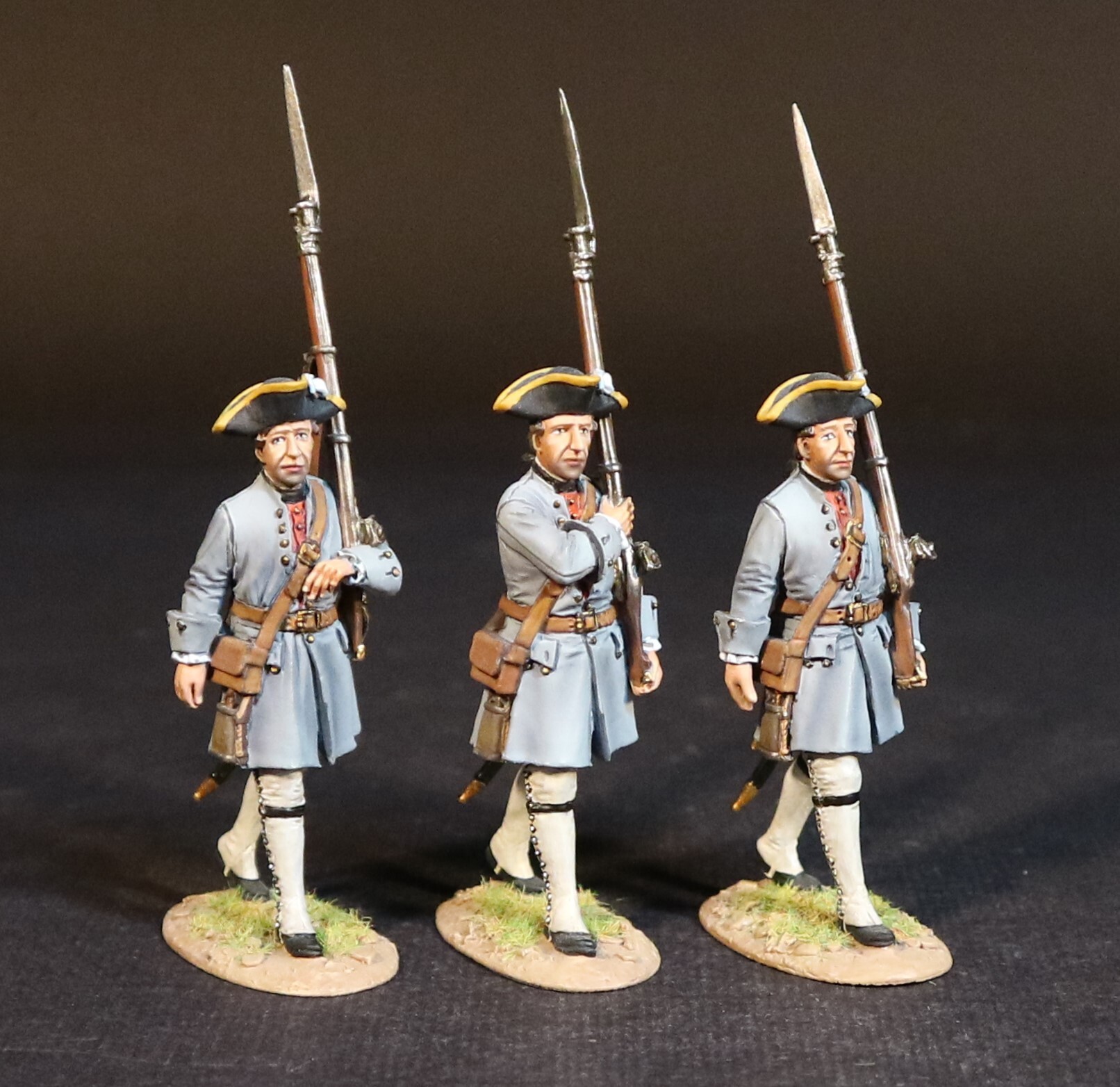
After the surrender of Pondicherry in 1761, the 2nd and 3rd battalions returned to France.
On December 10, 1762, when the French Army was reorganised, the regiment was disbanded and incorporated in the newly formed “Aunis Infanterie.”
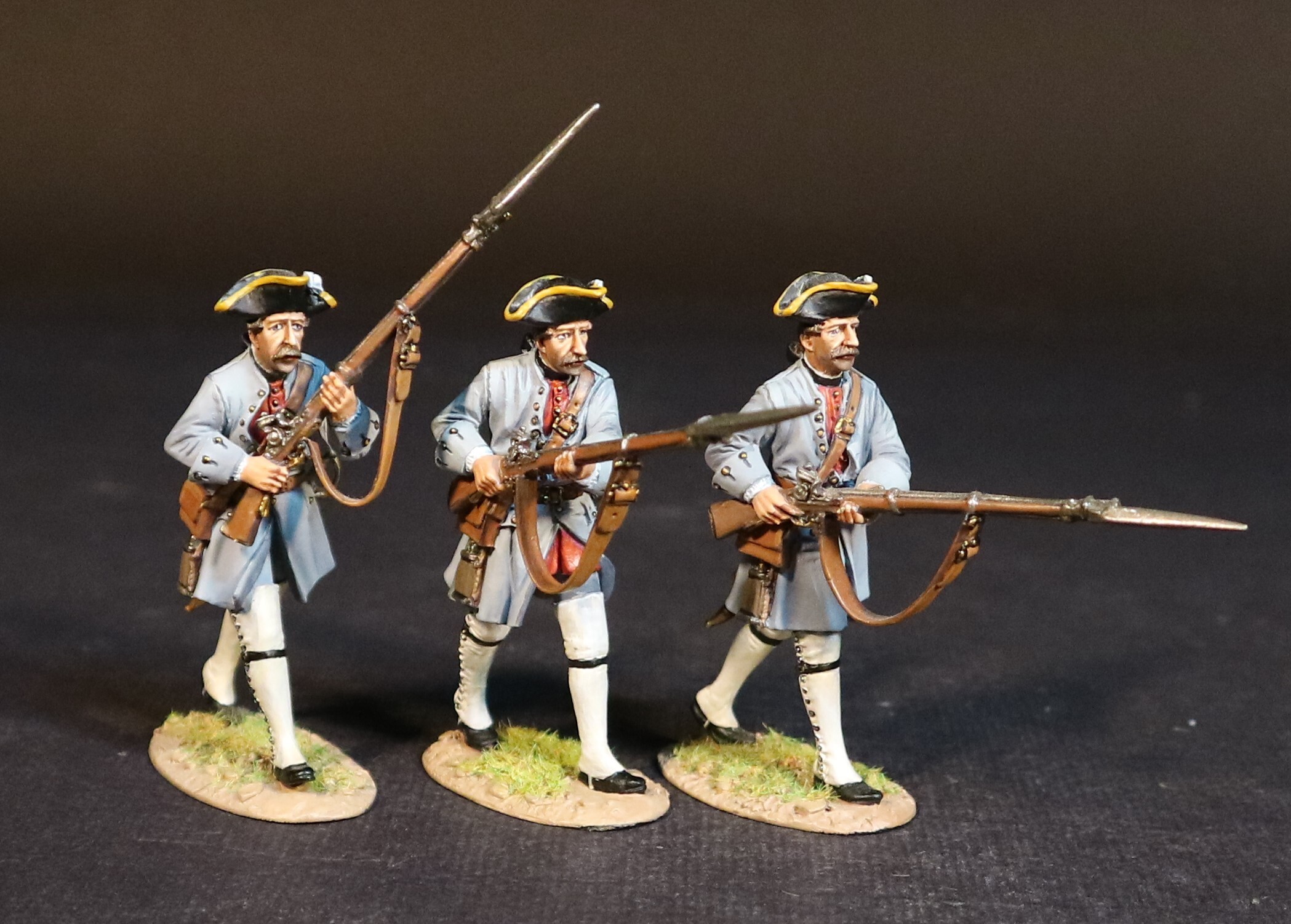
COMPAGNIE des INDES TROOPS
The troops raised by the Compagnie des Indes included infantry, dragoons, horse grenadiers and artillerymen.
From 1746 a large part of these troops were placed under the command of Charles Joseph Patissier de Bussy-Castelnau, more simply known as Bussy.
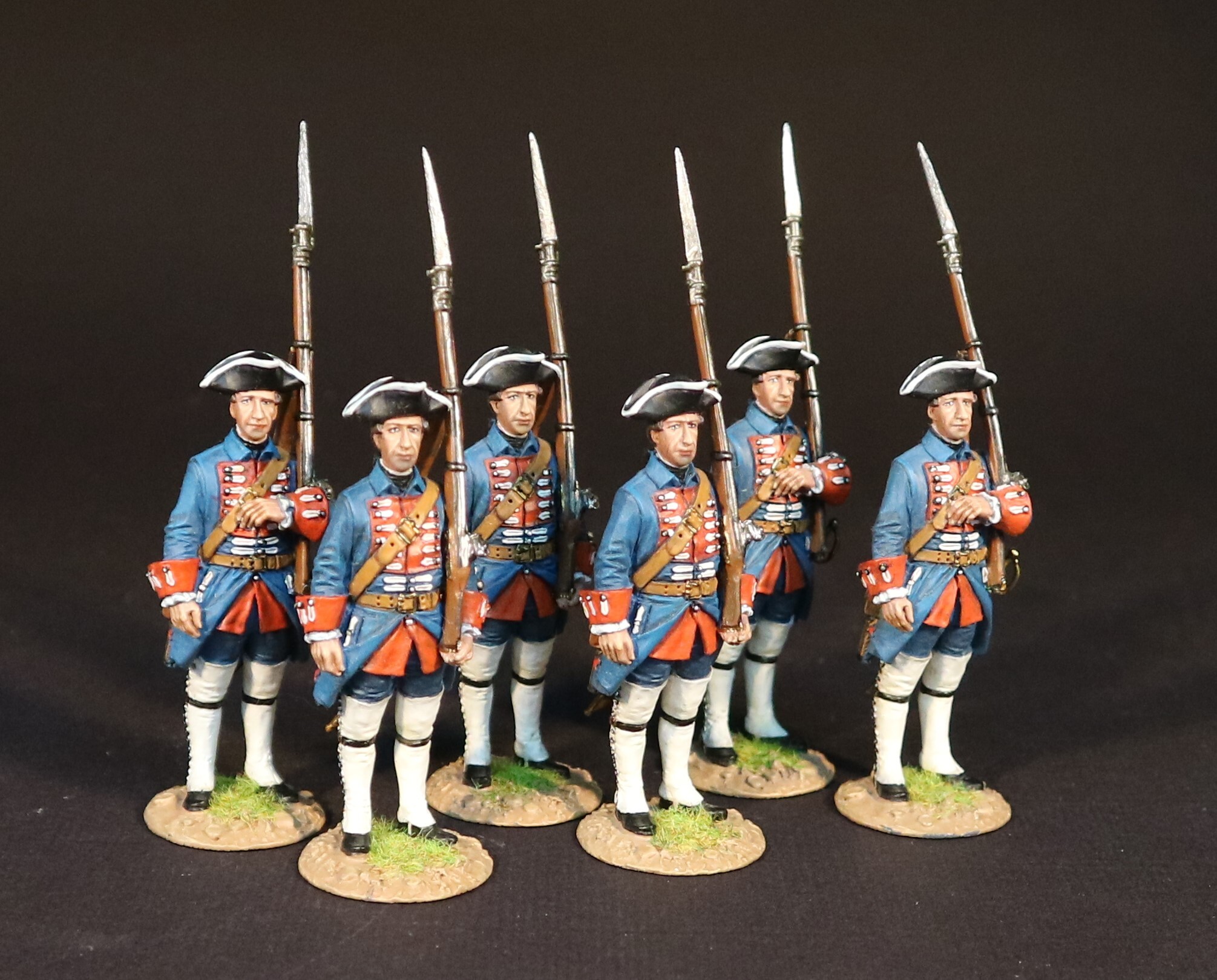
In 1756, 700 Europeans and 1,500 sepoys of the Compagnie des Indes relieved Vellore besieged by a British force under Major Killpatrick.
In 1760 troops of the Compagnie des Indes took part in the operations on the coast of Coromandel where, on January 22nd the Battaillon des Indes fought in the Battle of Wandewash.
From September, troops of the company were also present at the defence of Pondicherry who finally surrendered in January 1761.
FRENCH CIPAYE
The early French Cipayes, were similar to their British counterparts as they initially wore their own costume rather than a European style uniform.
These figures are based on the well known Rousselot renderings, and are wearing a muslin headdress with a wide flat top which it is believed was intended to protect the wearer against sword cuts. The conventional long gown which was fastened by ties on the left hand side, and was worn tucked up around the hips.
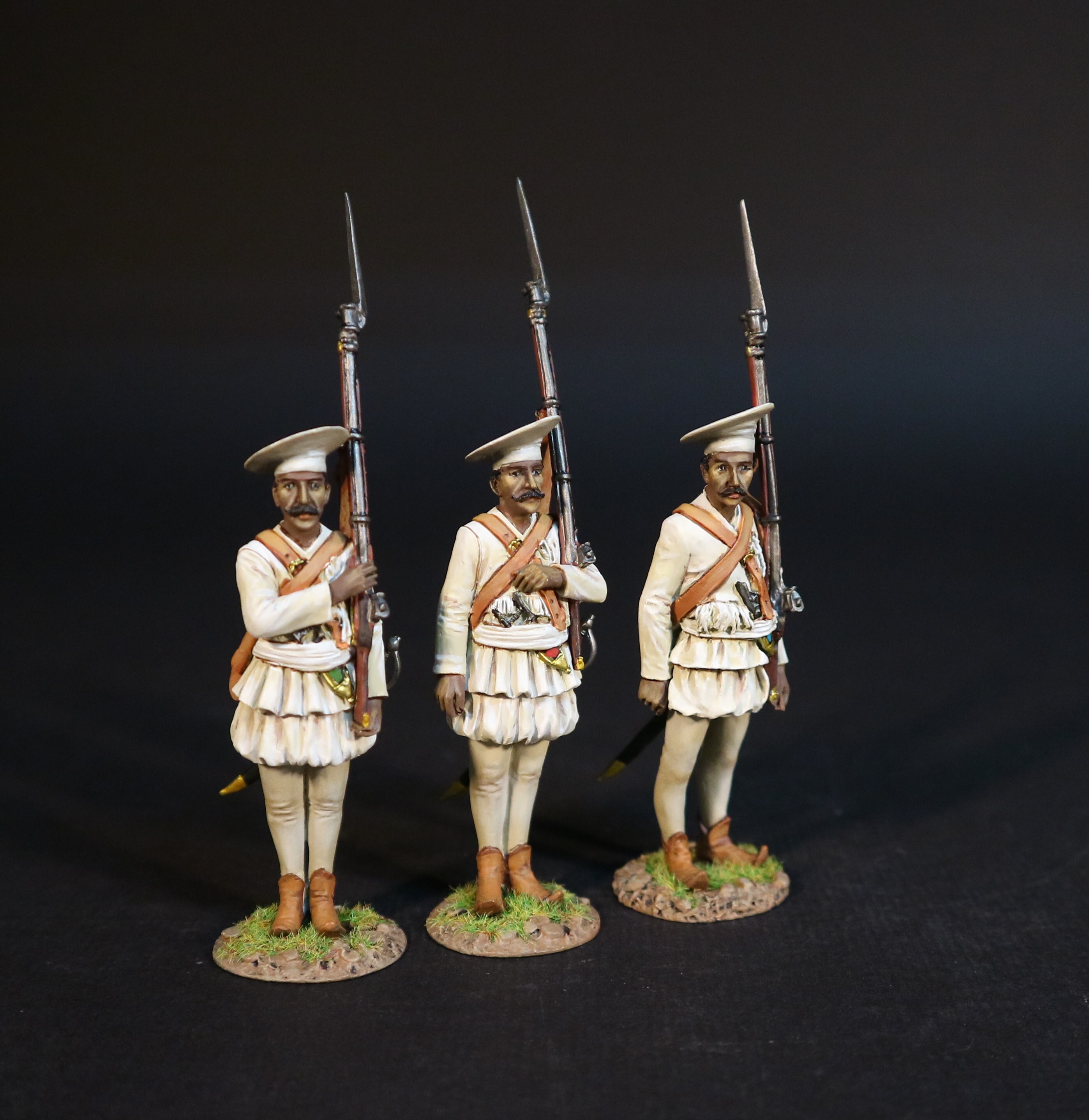
About 900 French Cipayes were positioned on a ridge slightly to the rear of the main French line. They were to take no part in the actual Battle of Wandewash. A further 300 Cipayes were left to guard the French camp
LALLY’S (IRISH) REGIMENT
During the Seven Years War the regiment was ranked 109th, and was under the command of Thomas Arthur Comte de Lally-Tollendal
On March 6 1757, the 2nd battalion of the regiment left Brest on board a squadron under the command of Admiral d'Aché to reinforce the French posts in India. The fleet pursued by British men-of-war loitered on the voyage to Mauritius. It then took three months on his passage to the Coast of Coromandel.
On April 25th 1758, the fleet transporting the 2nd battalion finally arrived before the British Fort St. David. The 2nd Battalion took part in the operations on the Coast of Coromandel and in the Siege of Fort St. David until its capitulation on June 2nd.
From December 1758 to February 1759, the battalion took part in the unsuccessful Siege of Madras.
In 1759 the 2nd Battalion took part in the operations on the coast of Coromandel. At the beginning of August, it was in garrison at Chittapett (present day Chetpet). It broke into open mutiny and marched out of the fort with the avowed intention of joining the British. Their officers followed them, and by promises to discharge the arrears of their pay, now several months overdue, succeeded in Conciliating most of them, but 60 men persisted in their resolution and deliberately carried it out.
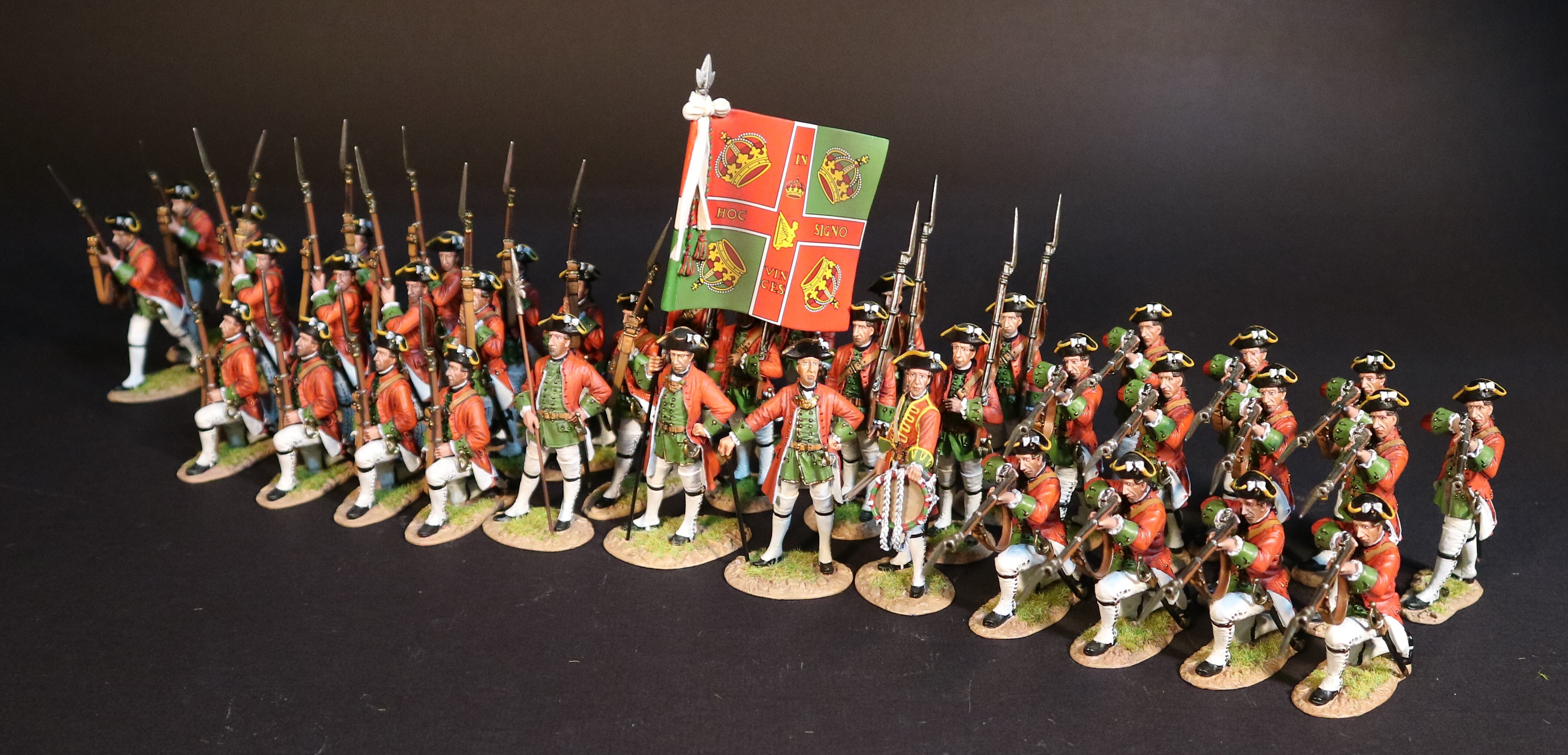
On January 22nd 1760, the battalion took part in the Battle of Wandewash.
Throughout the rest of the year, it was involved in the defence of Pondicherry. On September 4th, during the blockade of Pondicherry by a British amphibious force, Lally made an attack on the British camp which was repulsed after one redoubt had been taken by the French, 1 gun captured, 2 others spiked and a British officer and 3 men had been taken prisoner.
The Lally battalion was particularly distinguished in this occasion, losing 8 sergeants and 25 privates killed.
On January 15 1761, when Pondicherry surrendered, the regiment became prisoners of war.
Thomas Arthur, Comte de Lally, Baron de Tollendal (13th January 1702 – 9th May 1766) was a French general of Irish Jacobite ancestry. Lally commanded French forces including two battalions of his own red coated Regiment of Lally of the Irish Brigadde, in India during the Seven Years’ War.
After a failed attempt to capture Madras he lost the Battle of Wandewash to British forces under Eyre Coote and then was forced to surrender the remaining French post at Ponticherry.
After time spent as a prisoner of war in Britain, Lally voluntarily returned to France to face charges where he was beheaded for his alleged failures in India. Ultimately the jealousies and disloyalties of other officers, together with insufficient resources and limited naval support prevented Lally from securing India for France. In 1778, he was publicly exonerated by Louis XVI from his alleged crime.
ORDRE MINCE AND ORDRE PROFONDE
In the 18th century, a fierce debate arose among tacticians, some backing the ordre mince and some backing the ordre profond. Infantry fighting based itself on two concepts.
To give a brief idea of these two conceptions: proponents of the ordre mince considered that fire was the determining factor in a combat thus the more the front of a unit was extended the more one could inflict losses to the enemy, weakening him to get the upper hand.
The Line, ordre mince, favoured firepower, and allowed the largest number of men to fire on the enemy force. However it was not very mobile, and could be easily broken by a shock attack or by cavalry.
The proponents of the ordre profond argued that it was not fire but shock which was the determining factor, allowing to crush the enemy lines with 6 ranks deep (or more) columns bristling with bayonets.
The English preferred the Ordre Mince (thin order) and had even developed salvo firing by sections which allowed a group of men (on each volley) to create a gap in the opposing formation. Less professional armies used salvoes in line formation, with three ranks, having one rank fire while the other two reloaded.
It is argued that the losses to each salvo were divided up amongst the mass of the opposing unit, and thus had a less damaging effect on morale than fire by section.
During the Seven Years’ War, it is the ordre mince in 3 ranks which was the most commonly used when infantry units deployed in order of battle.
From 1754, in the French army firing was made by section, platoon, tiers de rang, demi-rang or battalion.
In 1755, the regulation specified that fire should start from the central part of the battalion and proceed outwards.
Exercises in garrison or in camps drew attention that in real combat situations, firing procedure were much more difficult.
The Encyclopédie of 1777 describes the action of an infantryman during combat as follows:
“Fire is most often very uncertain, and nothing is more true. Whatever the position of an infantry troop, in open terrain or in mountainous country, it is undisputable that wind, dust or sun, noise and smoke, who are unavoidable, perpetual movements and unevenness of terrain make soldiers knock each others, and change order and union of the various parts of a troop and expose it to break; the quickness with which a soldier charge his musket, makes him often spill half his cartridge, or push it only halfway in the barrel; the barrel becomes burning hot and clogged by dint of firing; the gun lock gets dry and breaks down, or whose flint does not produce sparks any more; finally the ardour who gets on their nerves and stuns them; all of this contribute to disturb the exactness of fire, and to considerably diminnish fire and its effect.”
It was in April 1759 that the war Minister, the Marechal de Belle-Isle, wrote to the Marechal de Contades, enjoining him to put his infantry in 6 ranks in encampment as well as in battle and to train them in this exercise.
The French armies of the 18th and early 19th centuries eventually placed a significant amount of emphasis on the ordre profonde, in part to counter the success of the English and Prussian ordre mince.
The ordre profonde was also appealing in that at least in theory, it would cure the problems with desertion, decisiveness and systematizing that the French had experienced throughout the 18th century, particularly in the Seven Years’ War.
THE FRENCH AND INDIAN WAR
THE SIEGE OF QUEBEC
THE BATTLE OF THE PLAINS OF ABRAHAM 1759
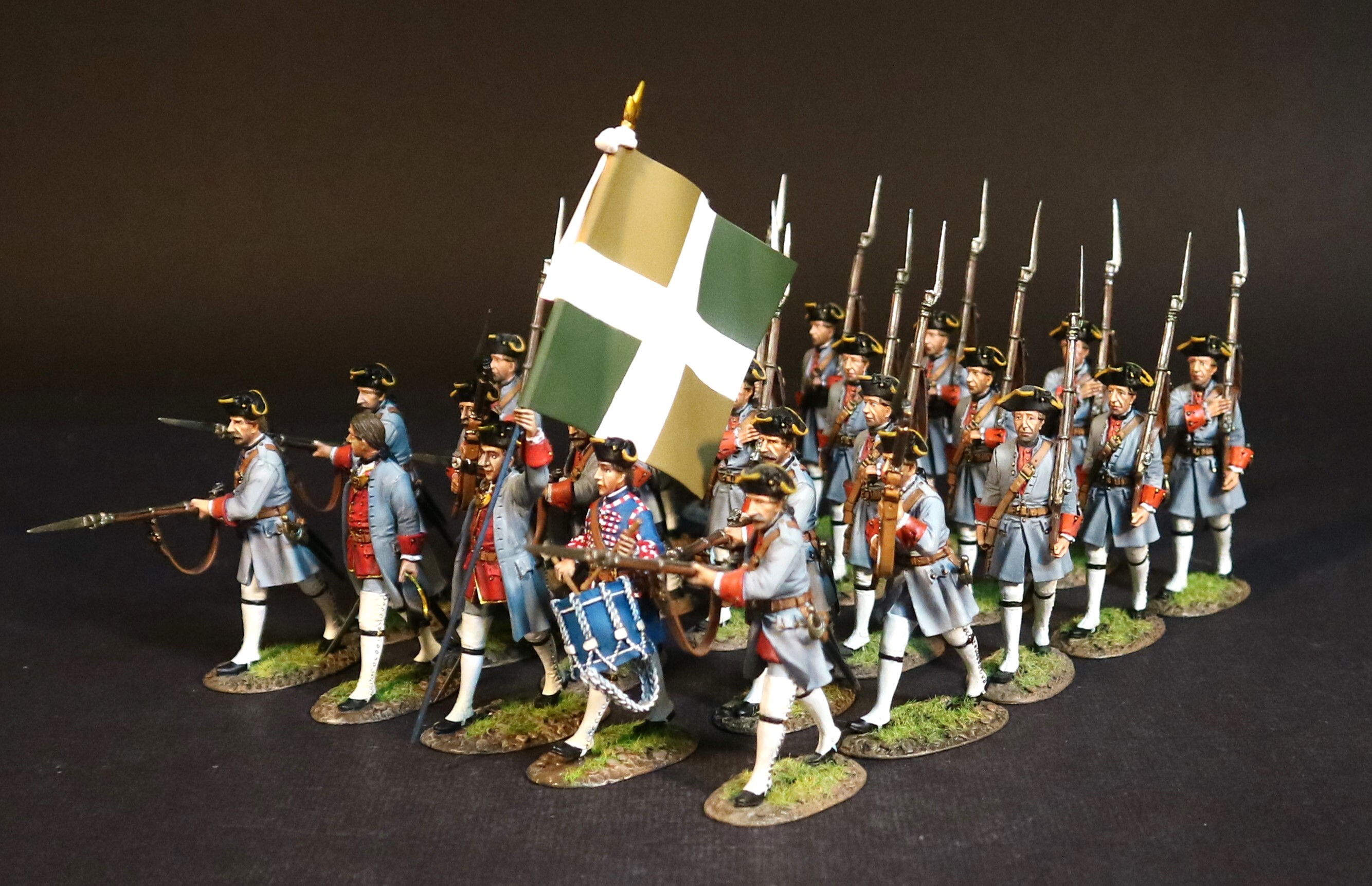
Please note these figures will also be repainted to represent Regiment de Guyenne, who took part in the Battle of the Plains of Abrahams 1759.
PLEASE NOTE THE FIRST OF THE NEW WANDEWASH SETS WILL BE AVAILABLE WITH THE DECEMBER RELEASES.